
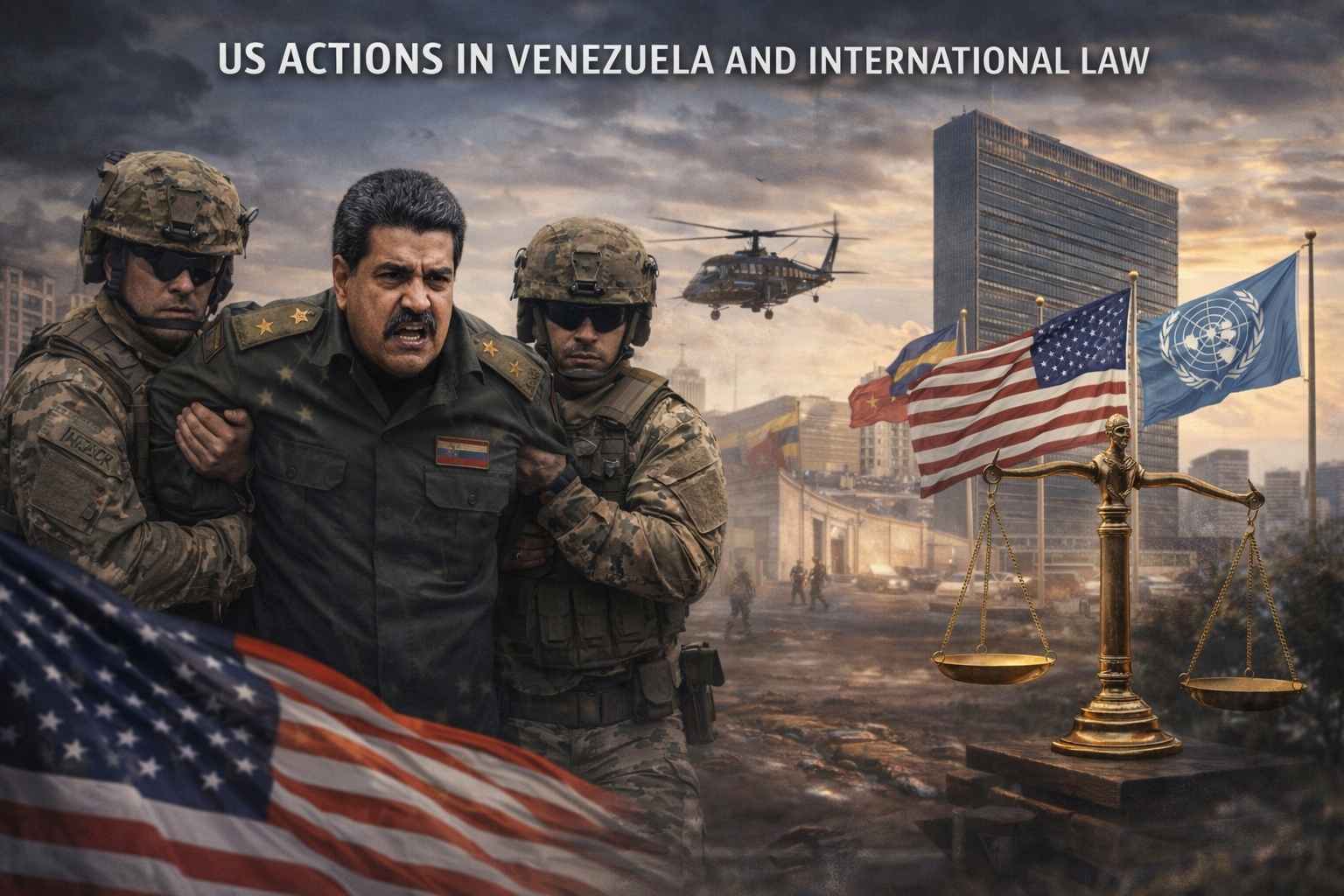
On January 3, 2026, the United States launched a major military operation against the Bolivarian Republic of Venezuela, culminating in the seizure and capture of Venezuelan President Nicolás Maduro and his wife, Cilia Flores. This unprecedented intervention by one sovereign state against another has triggered intense global debate — not only about the legality of the operation, but also about the integrity of the rules-based international legal system.
The operation included airstrikes, special forces action in Caracas, and the removal of Maduro, who was transported to the United States to face federal charges. The U.S. government has framed the assault as part of a campaign against alleged narco-terrorism and transnational crime. The strike followed months of escalating tension in the region and repeated U.S. military pressure around Venezuelan territorial waters and airspace.
US Attack on Venezuela and the Collapse of International Law
This event is widely interpreted by international law scholars, global institutions, and human rights organizations as one of the most significant violations of international legal norms in recent history. Many experts argue that it threatens the foundational principles of the modern international order — particularly:
-
State Sovereignty: An essential principle of international law that prohibits one state from intervening militarily in another’s affairs without consent or Security Council authorization.
-
Non-Use of Force: Article 2(4) of the United Nations Charter prohibits using force against another nation’s territorial integrity or political independence. Most legal commentators believe the U.S. action lacked lawful justification under this framework.
-
International Humanitarian and Human Rights Law: Observers have raised concerns not only about the legality of the strike itself but also about civilian harm and the treatment of detainees following the intervention.
Global and Institutional Reactions
United Nations
UN Secretary-General António Guterres publicly warned that U.S. actions could set a dangerous precedent for international peace and security, emphasizing that even powerful states are bound by the UN Charter and that force must not be used except in self-defence or with Security Council approval.
Independent UN investigative missions highlighted ongoing human rights concerns in Venezuela and underscored that violations by a state (whether Maduro’s government or otherwise) do not justify unlawful intervention by another.
Human Rights and Legal Organizations
Amnesty International condemned the strike as a clear violation of the UN Charter, characterizing it as an “act of aggression” that undermines the rules-based international order and endangers civilian populations. The group also stressed that justice for documented human rights abuses in Venezuela should proceed through lawful and accountable processes — not unilateral military force.
Legal experts have similarly described the U.S. raid as unlawful, lacking legitimate self-defence claims or Security Council authorization. Many argue it represents a profound breach of non-intervention norms and could weaken global legal institutions designed to prevent conflicts.
International Diplomatic Response
Numerous governments expressed concern or condemnation:
-
Latin American states condemned the use of force against a neighboring nation and warned of regional instability.
-
Russia and China labelled the U.S. actions as violations of international law and reaffirmed support for Venezuelan sovereignty.
-
Canada stressed the importance of upholding international legal standards, even while critiquing Venezuela’s political situation.
What the U.S. Claims — and the Legal Debate
The U.S. government justified its actions on several points, including:
✔ Allegations of transnational drug-trafficking networks tied to Maduro
✔ Claims of national security risk from illicit actors
✔ Assertions of moral imperative to protect civilians
However, international law experts widely reject these claims as insufficient to justify unilateral military intervention under established legal rules. The UN Charter requires either demonstrable self-defence or explicit UN Security Council authorization — neither of which was secured before the January intervention.
Critics also note that broad interpretations of threats like drug trafficking do not equate to an armed attack sufficient to justify pre-emptive or defensive use of force under international law.
Long-Term Implications for International Legal Order
Erosion of Established Norms
Scholars warn that the military action could weaken foundational legal restraints designed to prevent interstate conflict:
-
It may encourage other nations to justify force based on unilateral interpretations of security threats.
-
It could diminish confidence in the UN Security Council’s role as a chief arbiter of lawful use of force.
-
It risks emboldening powerful states to act with impunity outside accepted legal frameworks.
Geopolitical Precedent
By targeting another sovereign state so directly, the U.S. intervention may reshape expectations about military action in the Western Hemisphere and beyond. Observers caution that this could have ripple effects on disputes in regions such as Taiwan and Eastern Europe, where the balance between sovereignty and force remains sensitive.
Understanding the Legal and Global Context
Q: Was the U.S. attack on Venezuela legal under international law?
A: No — major international law experts and organizations argue it violated the UN Charter, specifically the prohibition on the use of force without self-defence justification or UN Security Council approval.
Q: What is Article 2(4) of the UN Charter?
A: It prohibits all UN member states from using force against another state’s territorial integrity or political independence, except in specific circumstances like self-defence or Security Council mandate.
Q: Did the U.S. receive UN authorization?
A: No formal UN Security Council resolution authorized the military action in Venezuela.
Q: Can a country use military force if it claims a security threat?
A: Only if the threat qualifies as an imminent armed attack or under a Security Council mandate. Allegations like narcotics trafficking are generally not seen as sufficient legal grounds without clear evidence of direct imminent danger.
Q: What are the broader implications for international law?
A: The event could weaken norms against unilateral force and reduce confidence in legal frameworks guiding peaceful interstate relations.
Conclusion
The U.S. military attack on Venezuela has sparked global controversy not just for its geopolitical consequences, but for what many view as a crisis of international law itself. Unilateral force against a sovereign nation without clear legal authority is seen by scholars and institutions as undermining the rules-based order that has governed international relations since World War II.
Whether this becomes a turning point for how international conflicts are resolved — or a cautionary chapter in legal history — remains the subject of ongoing global debate.