


Robin Lutz Beattie, Esq.
Defective Drug Recalls Lawyer
Ms. Beattie served as the Chair for the Family Law Section of the Colorado Bar Association in 2018 and 2019. Ms. Beattie is the Co-Chair of the Amicus Committee of the Family Law Section and serves on the Board of Directors of Court Support Jeffco. Ms. Beattie is listed in “Best Lawyers in America” and Super Lawyers and was the President of the First Judicial District Bar Association for the 2013-2014 term. Ms. Beattie carries a superb rating of 10/10 by the online lawyer directory Avvo personal injury law.
Although Ms. Beattie practiced civil litigation for several years, she has focused exclusively on family law for over a decade, and finds this field to be both challenging and meaningful. Ms. Beattie wrote the chapter on Spousal Maintenance for The Practitioner’s Guide to Colorado Domestic Relations Law and co-wrote an article for the January 2009 Colorado Lawyer: “Postsecondary Education Expenses After Chalat: Paying College Expenses After Divorce.” She has also presented lectures on many family law topics, ranging from jurisdiction to the drafting of Separation Agreements to the impeachment of valuation experts. In 2015, she co-chaired the 2015 Family Law Institute in Vail and in 2018 she was the Chair of the Family Law Institute. As Co-Chair of the Amicus Committee, Ms. Beattie has written several briefs to the Colorado Supreme Court concerning family law issues.
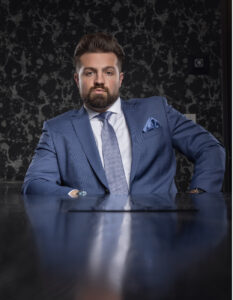
Eric Faddis
Defective Drug Recalls Lawyer
Eric is a personal injury attorney, trial lawyer, civil and criminal litigator, former felony prosecutor, and legal correspondent/media personality. He has been featured more than 350 times on networks/programs including Fox News, Court TV, NewsNation, Crime Stories with Nancy Grace, Newsmax, Law & Crime, The Sun, The Guardian, and other outlets for legal and political analysis on national cases and current events.
Before becoming a Founding Partner of Varner Faddis Elite Legal, Eric was an attorney at the prestigious firm of Springer & Steinberg, where he handled criminal and civil matters and learned from one of the best trial attorneys in the nation, Harvey Steinberg. Prior to that, Eric served as Deputy District Attorney for Arapahoe County in both the felony and Special Victims units. There, he prosecuted 1000s of cases including First Degree Murder, Aggravated Robbery, high-level Drug Trafficking, Sex Assault, Domestic Violence, and DUIs. Alongside now-judge Jay Williford, Eric handled the publicized and successful prosecution and trial of John Bowlen, son of Broncos owner Pat Bowlen.

Darin Schanker
Defective Drug Recalls Lawyer
When Darin L. Schanker started his career as a trial attorney three decades ago, he had a very specific vision in mind. As a Colorado native, he knew that his knowledge and abilities had a purpose; to protect the community from those with profit-driven motives and vast resources. Now a nationally respected trial attorney, Darin has dedicated his professional life to growing Bachus & Schanker, LLC, with that vision in mind.
Professionally, Mr. Schanker is first and foremost a trial lawyer. His practice is nationwide, and he has tried as lead counsel many different types of injury cases in both federal and state courts all over the country. He has litigated and tried cases from Alaska to Florida; New York to California; and dozens of states in between, with a focus in his home state of Colorado. Such trials have included defective medical devices, pharma cases, medical malpractice, civil sex assault, negligent security, as well as injuries from car crashes.
Darin has had the good fortune to achieve some nice results for worthy clients as lead trial counsel; these include the largest medical malpractice jury verdict ever in Colorado history, and the largest compensatory defective hip jury verdict ever in the country.

Daniel A. Sloane
Defective Drug Recalls Lawyer
Dan is a third-generation Denver native who has been representing injured clients for 15 years. Dan has been selected as a Top 100 Trial Lawyer by the National Trial Lawyers, named in Best Lawyers in America by U.S. News and World Report, selected as a Best Lawyer in Denver by the Denver Post and named one of Denver’s Top Lawyers by 5280 Magazine.
Since 1997, Attorney Sloane has been practicing civil trial law. For the past fifteen years, Dan’s scope of cases and clients have covered a broad spectrum of personal injury law. His most recent cases have been on those who have been impacted and victimized by sexual abuse and harassment. Dan was the key attorney on a recent case between a former student of Adams County in Colorado and a young man who was repeatedly assaulted by her teacher, Gilbert Trujillo. The winnings were $5 million for the case, which is the largest in Colorado state history under Title IX.
Jonathan Stine
Defective Drug Recalls Lawyer
Jonathan is a senior litigator at The Paul Wilkinson Law Firm, where he’s practiced law since 2013. He has been a partner at the Firm since 2017 and is directly involved in all aspects of the Firm’s cases and its day-to-day management and operations.
He specializes in all types of personal injury litigation, including motor car vehicle accidents, motorcycle accidents, semi-truck accidents, premise liability, traumatic brain injury, dog bites, excessive force, assault and battery, falling merchandise, and wrongful death cases. He also specializes in insurance breach of contract and insurance bad faith litigation.
Jonathan was born in Colorado Springs and has lived in Colorado his entire life. At a young age, Jonathan’s family moved to Parker, where he grew up and graduated from Ponderosa High School. Jonathan then attended the University of Colorado at Boulder, where he received two bachelor of arts degrees, one in Sociology and one in Philosophy.

Kurt Zaner
Defective Drug Recalls Lawyer
Kurt Zaner has dedicated his legal career to representing folks against the modern-day Goliaths. In battling corporations that refuse to take responsibility, Kurt enjoys the challenge of standing up for people that seemingly have the odds overwhelmingly stacked against them.
As a trained stage actor, Kurt credits much of his trial success to his theatrical training in college and in Los Angeles prior to law school.
After graduating law school near the top of his class and receiving the American Bar Association’s and American Law Institute’s Best Graduate Award – awarded to the one student of the graduating class who best represents a combination of scholarship and leadership – Kurt went on to clerk for United States District Judge Ken Marra.
Tess Fraser
Defective Drug Recalls Lawyer
Aaron is particularly skilled in handling cases involving community associations, construction disputes, mechanics’ liens, commercial leasing, and regulatory compliance. He also brings a wealth of knowledge in areas such as estate litigation, title matters, and forcible entry actions.
His prior work includes advising and representing individuals, homeowners, and corporate entities, as well as working on legislative initiatives and public education efforts related to community development and homeowners’ associations.
Aaron’s practical expertise, combined with his commitment to client advocacy, makes him a trusted attorney in navigating the complexities of civil and commercial law.


What Happens When a Product Gets Recalled?
A product recall is a significant event in consumer protection and business accountability. It occurs when a manufacturer or regulatory authority identifies a safety issue or defect with a product that could put consumers at risk or expose the company to legal challenges. This process is designed to protect public safety, maintain trust in markets, and manage the potential fallout from defective or hazardous products.
Why Do Products Get Recalled?
Products may be recalled for a variety of reasons, including:
Safety hazards (e.g., choking, fire risks, toxic materials)
Manufacturing defects
Incorrect or misleading labeling (such as undeclared allergens in food)
Regulatory non-compliance
The Product Recall Process
1. Detection and Investigation
The process typically starts when a company, consumer, or government agency detects a potential issue. This triggers an internal investigation, often involving product testing and hazard analysis to confirm the existence and scope of the problem. The investigation identifies:
The affected batches or models
Where the products are in the supply chain
The root cause of the issue
2. Notification and Reporting
Once a defect or danger is confirmed, the business notifies relevant regulatory agencies (such as the FDA or Consumer Product Safety Commission in the US). Reporting requirements and timelines vary by jurisdiction, but prompt notice is often required—sometimes within 24-48 hours. The product maker or supplier decides if a voluntary or compulsory recall is necessary.
3. Stopping Sale and Distribution
Affected products are immediately pulled from shelves and supply chains. Manufacturers may halt production to prevent further distribution of the dangerous item.
4. Customer and Public Notification
Consumers, distributors, and retailers are informed through various channels, such as:
Official recall notices (in stores, online, newspapers)
Direct communication (email, post—especially for identifiable product owners)
Social media and company websites
Recall notices specify which products are affected, the risks involved, and steps consumers should take (e.g., “Stop using the product immediately”).
5. Remedy Offered to Consumers
Consumers are generally advised to:
Return the product for a repair, replacement, or refund
Dispose of the item if return isn’t feasible (for safety reasons)
Follow company or government instructions for remedy
Manufacturers typically cover the costs involved and strive to make the process straightforward for affected consumers.
6. Product Collection and Disposition
Retailers and consumers return the recalled items. The company may:
Repair the product (e.g., replacing faulty parts)
Replace it with a safe version
Offer a full refund
Safely destroy or modify defective goods
All stages are documented for regulatory compliance.
7. Post-Recall Analysis
After the recall, the business analyzes the root causes of the defect, reviews the recall process, and often implements corrective actions to prevent future issues. A final report reconciles the number of items recalled versus those distributed.
Impact of a Product Recall
For Consumers
Safety is prioritized—remedies are provided, and further risk is minimized.
Legal rights allow for refunds or replacements, depending on the nature of the defect and usage history of the product.
Inconvenience can result from returning products or waiting for repairs.
For Companies
Recalls carry significant implications:
Financial costs: retrieval, disposal, replacement, notification, legal fees, and possible fines.
Reputational damage: loss of trust and customer loyalty, negative publicity, and decreased sales.
Operational disruption: supply chain interruptions and resource reallocation.
Legal and regulatory risks: lawsuits and penalties for failing to comply.
Long-term, the fallout from a recall can persist, affecting market position, investor trust, and internal morale.
Conclusion
A product recall is a complex, multi-step process designed to safeguard consumers and maintain the integrity of marketplaces. While challenging for businesses, effective recalls are a vital component of product safety and consumer rights. Companies must act swiftly, transparently, and generously to minimize harm and restore trust.